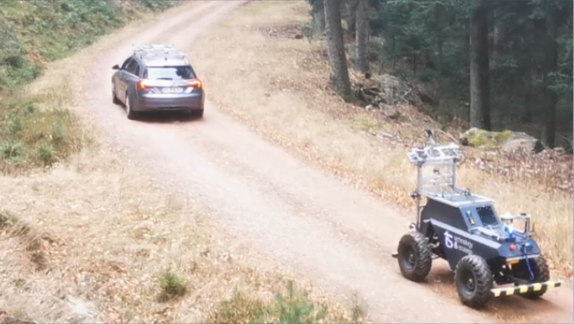

Understanding Autonomous Vehicle Technology Fundamentals
When a vehicle navigates a complex urban intersection without human intervention, processing multiple sensor inputs while making split-second decisions, we witness the culmination of decades of engineering evolution. According to recent industry data, over 70% of critical safety incidents in autonomous vehicle testing stem not from algorithmic failures but from integration gaps between sensing, perception, and decision-making subsystems.
Autonomous vehicles represent one of the most complex engineering challenges of our generation, requiring seamless integration of hardware, software, and AI systems that must perform flawlessly under unpredictable conditions. This multidisciplinary challenge demands expertise spanning sensor technology, embedded systems, artificial intelligence, and most critically, safety-critical systems engineering.
The Six Levels of Vehicle Autonomy Explained
The Society of Automotive Engineers (SAE) has established a standardized classification system that defines six levels of driving automation, from Level 0 (fully manual) to Level 5 (fully autonomous). This taxonomy serves as a fundamental framework for the industry, providing clarity around capabilities and limitations of various systems.
From our experience implementing Level 2+ systems for major European OEMs, the transition from Level 2 to Level 3 represents not an incremental step but a fundamental architectural shift. This transition requires reimagining safety architectures to accommodate the handover of responsibility between vehicle and driver—a challenge requiring expertise in both human factors engineering and safety-critical systems.
Core Sensing Technologies in Autonomous Driving
Autonomous vehicles rely on a diverse sensor suite to perceive their environment. Each sensor type offers unique capabilities and limitations:
- Camera Systems: Provide rich visual information, enabling object classification and lane detection. However, they struggle in adverse weather and lighting conditions.
- LIDAR (Light Detection and Ranging): Offers precise 3D mapping by measuring laser light reflections. Modern solid-state LIDAR units deliver high-resolution point clouds essential for accurate environmental modeling.
- Radar: Utilizes radio waves to detect objects and measure their velocity directly. Radar excels in adverse weather conditions and provides reliable long-range detection.
- Ultrasonic Sensors: Provide short-range detection critical for parking and low-speed maneuvering. These cost-effective sensors complement the longer-range sensing suite.
- GNSS and IMU: Global Navigation Satellite Systems combined with Inertial Measurement Units provide localization capabilities with centimeter-level accuracy under optimal conditions.
In our work developing sensor fusion algorithms for premium European automakers, we've found that the integration architecture is as important as the sensors themselves. A well-designed fusion approach mitigates individual sensor limitations while exploiting their complementary strengths, creating a system that exceeds the capabilities of any single sensing modality.
Computing Architecture Behind Self-Driving Vehicles
The computing infrastructure powering autonomous vehicles must process massive data streams from multiple sensors in real-time while executing complex algorithms with deterministic performance. Modern autonomous driving platforms typically employ a heterogeneous computing architecture consisting of:
- Central Compute Units: High-performance SoCs combining CPUs, GPUs, and specialized accelerators to handle intensive computational requirements
- Domain Controllers: Intermediate processing units managing specific subsystems such as sensor pre-processing or vehicle dynamics control
- Sensor Processing Units: Dedicated hardware for initial data processing at the sensor level
- Redundant Safety Systems: Independent monitoring systems providing fail-operational capabilities
From our experience implementing centralized computing architectures for ADAS systems, scalability and thermal management represent critical engineering challenges. Systems must accommodate continuous software updates while maintaining real-time performance within the constrained automotive environment.
Critical Safety Systems for Autonomous Vehicles
Functional Safety Architecture for Autonomous Driving
Functional safety forms the cornerstone of autonomous vehicle design, ensuring system behaviors remain safe even when failures occur. Unlike conventional automotive systems, autonomous driving technology must contend with novel challenges that extend beyond traditional functional safety approaches.
The ISO 26262 standard provides the foundation for automotive functional safety, defining a comprehensive framework for managing safety throughout the development lifecycle. However, autonomous systems introduce complexities that the standard wasn't originally designed to address fully.
"Our safety-critical systems engineering approach draws from aerospace methodologies, ensuring autonomous vehicle systems maintain safety integrity even under component failures or environmental challenges."
- Vincent Person, Safety Engineer at T&S
A robust functional safety architecture for autonomous vehicles typically implements:
- Safety Goals and Requirements Decomposition: Systematic breakdown of high-level safety objectives into implementable requirements
- Redundant Sensing and Actuation Paths: Independent channels enabling continued operation despite individual component failures
- Monitoring and Diagnostics: Comprehensive monitoring of system health with appropriate degradation strategies
- Safe States Management: Predefined fallback behaviors for various failure scenarios
- Verification and Validation: Rigorous testing methodologies providing evidence of safety requirement fulfillment
When designing safety architectures for Level 3+ systems, we integrate SOTIF (Safety Of The Intended Functionality) principles alongside traditional functional safety approaches. This addresses performance limitations and foreseeable misuse scenarios that fall outside the scope of ISO 26262.
From Aerospace to Automotive: Transferring Critical Systems Expertise
The aerospace industry has decades of experience developing highly reliable systems where failures can have catastrophic consequences. This expertise offers valuable lessons for autonomous vehicle development, particularly regarding safety-critical systems engineering.
Key principles from aerospace that enhance automotive safety practices include:
- Design Assurance Levels: The DO-178C standard provides rigorous software development frameworks based on criticality
- Independence in Verification: Mandated independence between development and verification activities
- Formal Methods: Mathematical proof techniques for verifying properties of autonomous driving algorithms
- Safety Margins: Conservative design approaches accounting for uncertainty and providing operational buffers
In our cross-sector projects combining aerospace methodologies with automotive development processes, we've found that adapting rather than directly transplanting aerospace practices yields the best results. The automotive industry operates under different cost, scale, and time-to-market constraints that necessitate tailored approaches while maintaining safety integrity.
Redundancy Design Principles for Self-Driving Cars
Sensor Redundancy Strategies
Reliable environmental perception requires thoughtful sensor redundancy strategies that balance cost constraints with safety requirements. Effective approaches include:
- Heterogeneous Redundancy: Deploying different sensing technologies (LIDAR, radar, camera) operating on different physical principles
- Overlapping Fields of View: Strategic sensor placement creating overlapping coverage zones
- Analytical Redundancy: Advanced algorithms inferring missing information by correlating data from functioning sensors
- Dynamic Reconfiguration: Adaptive perception pipelines that reconfigure based on available sensor inputs
Computing Platform Failover Systems
The computing architecture supporting autonomous driving must maintain operational capability despite hardware or software failures. Key redundancy approaches include:
- Lockstep Processing: Duplicate execution of critical algorithms with comparison of results to detect processing errors
- Diverse Implementation: Critical functions implemented using different algorithms or programming approaches
- Hot Standby Systems: Secondary computing platforms maintained in operational state, ready to assume control instantly
- Graceful Degradation: Tiered functionality levels that progressively reduce capability rather than complete system shutdown
Drawing from aerospace experience, we implement Byzantine fault tolerance concepts in our autonomous driving computing platforms, enabling correct system operation even when some components provide conflicting information.
Perception and Decision-Making in Autonomous Systems
Sensor Fusion Techniques for Enhanced Environmental Awareness
Sensor fusion represents the technological cornerstone of autonomous vehicle perception, combining data from diverse sensors to create a comprehensive and robust environmental model. Effective fusion architectures overcome individual sensor limitations while leveraging their complementary strengths.
The primary fusion approaches deployed in production autonomous systems include:
- Low-Level (Early) Fusion: Raw sensor data combined before feature extraction, creating unified data representation
- Feature-Level (Mid) Fusion: Each sensor independently extracts features, then combined into unified environmental model
- Decision-Level (Late) Fusion: Each sensor independently generates high-level interpretations, with fusion occurring at decision stage
Our implementations typically employ a hybrid fusion architecture, applying different fusion methods depending on the specific perception task. For instance, we utilize early fusion for precise localization using camera and LIDAR data, while employing late fusion for redundant object classification across different sensor modalities.
A particularly challenging aspect of sensor fusion involves temporal alignment and calibration maintenance. Drawing from our aerospace experience, we've developed robust online calibration monitoring techniques that detect subtle sensor misalignments during operation.
AI-Powered Perception Algorithms for Complex Scenarios
Modern autonomous perception relies heavily on deep learning approaches that have revolutionized the field's capabilities. Key applications include:
- Object Detection and Classification: Convolutional neural networks identify and categorize road users and infrastructure elements
- Semantic Segmentation: Pixel-level classification provides detailed scene understanding, distinguishing between drivable surfaces and obstacles
- Instance Segmentation: Algorithms distinguish between individual instances of the same class—critical for tracking multiple vehicles
- Multi-Object Tracking: Temporal correlation algorithms track objects over time, maintaining identity and predicting future positions
While these AI systems deliver impressive performance, their deployment in safety-critical applications presents unique challenges. Drawing from our cross-industry experience, we've developed a systematic approach to AI safety assurance that includes comprehensive edge case identification, explainability methods, and runtime monitoring systems.
Decision-Making Frameworks for Autonomous Vehicles
The decision-making system transforms perception outputs into driving actions, representing the "brain" of the autonomous vehicle. Effective architectures typically include:
- Behavioral Planning: High-level decision-making determining appropriate maneuvers based on traffic rules and conditions
- Motion Planning: Trajectory generation converting behavioral decisions into specific paths
- Control Execution: Low-level controllers translating planned trajectories into actual steering, acceleration, and braking commands
Modern systems increasingly employ hybrid approaches that combine rule-based safety guardrails, machine learning for nuanced social interactions, and optimization-based planning that balances multiple competing objectives.
Handling Edge Cases and Unexpected Situations
The true challenge of autonomous driving lies not in handling common scenarios but in responding appropriately to rare edge cases. Our approach to this challenge includes:
- Scenario-Based Development: Systematic identification and categorization of challenging scenarios
- Defensive Driving Principles: Conservative planning with appropriate safety buffers accounting for uncertainty
- Fallback Strategy Hierarchy: Tiered response protocols for different types of system limitations
- Runtime Monitoring: Continuous evaluation of system confidence and performance
Validation and Verification of Autonomous Systems
Comprehensive Testing Methodologies for Self-Driving Technology
Validating autonomous driving systems presents unprecedented challenges due to the near-infinite variety of real-world driving scenarios and the complexity of AI-based perception and decision systems. A comprehensive validation approach requires multi-layered testing strategies:
- Requirements-Based Testing: Systematic verification of system compliance with functional and performance specifications
- Fault Injection Testing: Deliberate introduction of hardware and software faults to evaluate system resilience
- Stress Testing: Evaluation of system behavior under extreme conditions
- Edge Case Testing: Focused evaluation of identified corner cases and rare scenarios
- Regression Testing: Continuous verification that new features don't compromise existing functionality
Drawing from our experience implementing aerospace-grade validation frameworks, we've developed a comprehensive test taxonomy for autonomous systems that ensures systematic coverage across both anticipated operational scenarios and potential failure modes.
Simulation-Based Validation Approaches
Simulation provides the scale and reproducibility needed to validate autonomous systems across millions of scenarios, enabling comprehensive testing that would be impractical in physical environments. Effective simulation strategies include:
- Physics-Based Sensor Simulation: High-fidelity models of sensor physics accurately representing environmental interactions
- Scenario Generation: Procedural creation of diverse test scenarios based on real-world data and parameterized variations
- Software-in-the-Loop (SIL): Integration of actual perception and decision software into simulation environments
- Hardware-in-the-Loop (HIL): Combination of actual hardware components with simulated inputs
- Digital Twins: High-fidelity virtual representations of specific vehicle configurations
"In our simulation implementations for European OEMs, we've developed scenario coverage methodology that combines targeted test cases for known edge cases with automated variation to uncover unknown weaknesses."
- Matthieu Sauvage, Technical Director at T&S
Real-World Testing Protocols for Autonomous Vehicles
While simulation forms the foundation of autonomous system validation, physical testing remains essential to verify performance in actual operating conditions. Structured approaches include:
- Closed Course Testing: Controlled environments allowing reproduction of specific scenarios with physical vehicles
- Shadow Mode Evaluation: Passive operation comparing autonomous system decisions against human drivers
- Pilot Deployments: Limited operational testing in constrained environments with safety monitoring
- Long-Tail Data Collection: Targeted real-world driving focused on collecting rare events and edge cases
- Graduated Exposure: Methodical expansion of operational domain from simple to complex environments
Our testing protocols incorporate methodologies from aerospace flight testing, establishing clearly defined acceptance criteria and test progression gates that must be satisfied before expanding operational envelopes.
Cybersecurity Challenges in Connected Autonomous Vehicles
Threat Models for Self-Driving Vehicles
Connected autonomous vehicles present a substantially expanded attack surface compared to traditional vehicles, combining automotive vulnerabilities with potential entry points from connectivity features. Comprehensive threat modeling must consider:
- External Communication Interfaces: Vehicle-to-everything (V2X) communications, cellular connectivity, Bluetooth, Wi-Fi protocols
- Sensor Spoofing and Jamming: Attacks targeting environmental sensors through signal interference or manipulation
- Software Supply Chain: Vulnerabilities introduced through third-party components or development tools
- Physical Access Scenarios: Attacks requiring direct physical access to vehicle systems
- Data Privacy Concerns: Exfiltration of sensitive information including location data and cabin recordings
Drawing from our experience implementing the ISO 21434 automotive cybersecurity standard, we've developed structured threat analysis methodologies that systematically evaluate both known attack patterns and emerging threat vectors.
Secure Communication in V2X Environments
Vehicle-to-everything (V2X) communication enables critical safety features and traffic optimization but introduces significant security challenges. Robust V2X security architectures must include:
- Message Authentication: Cryptographic verification of message origins and integrity
- Certificate Management: Scalable public key infrastructure supporting secure credential distribution
- Privacy Protection: Mechanisms enabling secure communication without compromising user privacy
- Misbehavior Detection: Systems identifying and mitigating potentially compromised participants
- Secure Hardware Integration: Hardware security modules protecting cryptographic keys
Our V2X security implementations leverage cross-industry expertise from secure communications systems, employing defense-in-depth strategies that maintain critical safety functionality even when parts of the security infrastructure are compromised.
Over-the-Air Updates and Security Maintenance
The ability to remotely update vehicle software provides essential security maintenance capabilities but also introduces potential vulnerabilities if not properly secured. Key security measures include:
- Secure Bootloaders: Verification of software authenticity before execution
- Code Signing: Cryptographic signatures verifying software originality and integrity
- Secure Update Protocols: Encrypted and authenticated communication channels for software delivery
- Rollback Protection: Mechanisms preventing installation of outdated software versions
- Update Atomicity: Ensuring updates either complete successfully or return to known-good state
- Monitoring and Logging: Comprehensive audit trails of update activities
By applying principles from mission-critical aerospace software management, our OTA security architecture implements a multi-stage validation approach that verifies updates across multiple dimensions before allowing them to affect vehicle operation.
Regulatory Landscape and Certification Processes
Current Regulatory Frameworks for Autonomous Vehicles
The regulatory environment for autonomous vehicles continues to evolve, with frameworks developing at different paces across regions. Key regulatory approaches include:
- United Nations Economic Commission for Europe (UNECE): WP.29 has developed regulations specifically addressing automated driving systems
- European Union: Building on UNECE frameworks with additional requirements around data recording and cybersecurity
- United States: Patchwork approach combining federal guidelines with varying state-level legislation
- China: Rapidly developing national standards through the China Industry Innovation Alliance for Intelligent and Connected Vehicles
Our regulatory compliance team maintains active engagement with developing standards, participating in working groups and implementing emerging requirements into our development methodologies well ahead of enforcement deadlines.
Certification Challenges for Self-Driving Systems
The certification of autonomous systems presents unique challenges that traditional type approval processes weren't designed to address:
- AI Verification: Traditional certification relies on deterministic testing, while AI-based systems require statistical approaches
- Operational Design Domain Definition: Precisely defining conditions under which autonomous systems can safely operate
- Scenario Coverage: Demonstrating sufficient testing coverage across virtually unlimited driving scenarios
- Software Updates: Certification processes must accommodate frequent software updates without complete recertification
- Evidence Generation: Producing volume and quality of evidence required to demonstrate safety
Drawing from our aerospace certification experience, we've developed structured assurance case methodologies that organize evidence hierarchically, connecting high-level safety claims to specific test results through clearly articulated arguments.
International Standardization Efforts
Standards development organizations worldwide are working to establish cohesive frameworks for autonomous vehicle development, testing, and deployment:
- ISO 21448 (SOTIF): Addresses safety of intended functionality, complementing ISO 26262
- ISO/PAS 22736: Provides taxonomy and definitions for operational design domains
- IEEE P2846: Focuses on assumptions for autonomous systems, particularly human driver behavior models
- UL 4600: Addresses safety principles and processes for evaluating autonomous products
Our standards experts actively contribute to these developing frameworks, ensuring our methodologies remain aligned with international best practices while helping shape standards that balance innovation with safety.
The Road Ahead: Emerging Trends in Autonomous Transportation
Technology Convergence: Electric, Connected and Autonomous
The future of mobility is shaped by the convergence of three transformative technologies: electrification, connectivity, and autonomy. This convergence creates both challenges and opportunities:
- Integrated System Optimization: Electric vehicle architectures offer advantages for autonomous systems
- Energy Management: Autonomous driving algorithms must consider energy optimization alongside safety and efficiency
- Shared Mobility Models: Combination of electric and autonomous technologies enables new service-based mobility models
- Data Ecosystem Integration: Connected autonomous vehicles become nodes in broader intelligent transportation systems
Our cross-domain expertise spanning electrification and autonomous systems enables integrated architecture development that optimizes across these converging technologies, creating solutions that address the complete mobility ecosystem.
Infrastructure Requirements for Wide-Scale Autonomous Deployment
While autonomous vehicles aim to operate within existing infrastructure, certain enhancements can significantly improve their performance and safety:
- Digital Infrastructure: High-definition maps, real-time traffic information, and road condition updates
- Communication Networks: Reliable, low-latency connectivity supporting V2X capabilities
- Smart Intersections: Infrastructure-based sensing at complex intersections supplementing vehicle sensors
- Physical Infrastructure Standards: Consistent road markings, signage, and maintenance practices
- Regulation and Governance: Legal frameworks defining liability, data ownership, and operational requirements
Drawing from our experience in smart city initiatives, we've developed a layered approach to infrastructure planning that balances immediate deployment needs with long-term optimization.
The Future of Human-Machine Interaction in Autonomous Vehicles
As vehicles become increasingly autonomous, the relationship between humans and vehicles fundamentally changes, creating new interaction paradigms:
- Transitional Control Interfaces: Systems effectively managing handover between autonomous and manual driving modes
- Trust Calibration: Interfaces accurately communicating system capabilities and limitations
- Passenger Experience Design: Interior configurations optimized for passengers rather than drivers
- Exterior Communication: Systems communicating vehicle intentions to other road users
- Accessibility Enhancements: Autonomous mobility services designed to accommodate users with diverse abilities
Our human factors specialists combine expertise from automotive, aerospace, and consumer electronics domains to create intuitive interfaces that build appropriate trust while maintaining user engagement.
How T&S Engineers Autonomous Vehicle Solutions
Our Cross-Sector Approach to Autonomous System Development
Technology & Strategy's distinctive approach to autonomous vehicle development leverages our cross-industry expertise, particularly the transfer of methodologies from aerospace and defense sectors to automotive applications:
- Safety-Critical Systems Engineering: Application of aerospace-grade safety processes ensuring robust operation under component failures
- Systems of Systems Integration: Expertise in managing complex interactions between subsystems developed by different teams
- Certification Methodologies: Structured approaches to evidence generation and assurance case development
- Cross-Domain Optimization: Balanced consideration of competing requirements across functional safety, cybersecurity, performance, and cost
Our engineers bring experience from multiple industries, applying proven approaches from mature domains to the emerging challenges of autonomous vehicles. This perspective enables innovative solutions that might be overlooked within a single-industry focus.
Case Studies: Advanced Driver Assistance Systems Implementation
Premium European OEM Highway Pilot System: T&S engineers developed a sensor fusion architecture for a Level 2+ highway assistance system, combining radar, camera, and ultrasonic inputs to enable hands-off highway driving. Our team implemented a gradual degradation strategy that maintained partial functionality during sensor impairments, significantly improving system availability while maintaining safety.
Commercial Vehicle Platooning Technology: For a commercial vehicle manufacturer, we designed and implemented a V2V communication system enabling truck platooning with dynamically adjustable following distances. The system incorporated cybersecurity protections derived from defense communications systems, ensuring resilience against potential interference.
Parking Assistance System Optimization: Our team enhanced an existing parking assistance system by applying advanced sensor fusion techniques that improved performance in challenging lighting conditions. The upgraded system demonstrated a 35% improvement in detection reliability while reducing false positives by over 40%.
These implementations demonstrate our ability to deliver concrete improvements in real-world ADAS systems, applying our cross-sector expertise to solve specific technical challenges while integrating seamlessly with existing vehicle architectures.
Collaborative Innovation in Self-Driving Technology
Autonomous vehicle development requires collaboration across traditionally separate domains. T&S facilitates this integration through:
- Interdisciplinary Engineering Teams: Project teams combining expertise in hardware, software, AI, safety engineering, and human factors
- Supplier Integration: Helping OEMs effectively integrate components and subsystems from multiple suppliers
- Academic Partnerships: Collaboration with research institutions keeping approaches aligned with latest technological developments
- Cross-Industry Working Groups: Active participation in standards development and industry consortia focused on autonomous driving challenges
By fostering these collaborative approaches, we help accelerate autonomous vehicle development while maintaining the rigorous engineering practices essential for safety-critical systems.
The journey toward fully autonomous vehicles represents one of the most complex engineering challenges of our time, requiring expertise across multiple domains and disciplines. Technology & Strategy's cross-sector approach, combining aerospace-grade safety methodologies with automotive-specific implementation experience, provides a unique value proposition for companies navigating this challenging landscape.
Our ability to integrate safety-critical systems engineering with cutting-edge AI and sensor technologies enables the development of autonomous systems that are both innovative and trustworthy. As the autonomous vehicle industry continues to mature, this balanced approach—maintaining rigorous safety standards while embracing technological advancement—will be essential for delivering on the promise of safer, more efficient transportation.
To learn more about how Technology & Strategy can support your autonomous vehicle initiatives, explore our smart validation capabilities or contact our automotive engineering specialists for a consultation on your specific challenges.